
Christopher Nolan’s Heroes Keep Saving the World – But Losing Home
The smallest act: On Purpose, Obsession, and the Architecture of a Life
PhilipRomano, CC-BY-SA-4.0
There is a story I once heard during my years studying Tibetan Buddhism under one of its most revered teachers. [The story has been edited for clarity, while it remains in the spirit of “Thus have I heard.”] A Buddhist is sent to a Muslim country with a strange assignment to open a small shop, maybe a tea shop. Not to convert anyone. Not to build a community. Not to spread Dharma. Simply to be there – a point of contact, a presence. And the entire purpose of this improbable mission is one single human being who will walk through the door one day – perhaps with a question, a doubt, a moment of openness that needs exactly this encounter.
When that person arrives, you help them. And the mission is complete. You close the shop. You leave. No pride. No drama. No narrative of heroism.
The story is deceptively simple, but its implications are enormous. It suggests that the “greater good” may not be collective at all. It may be one person. One life. One moment. A single karmic thread that justifies an entire journey.
This idea – that purpose can be explicit rather than grand – stands in stark contrast to the cultural obsession with scale. We are taught to serve nations, movements, traditions, causes. We are taught to measure impact by numbers. But the story flips the axis: it is not a story of the masses. Of the institution. But of the one person whose life intersects with yours in a way that matters. Not because the individual matters more than the collective but because awareness begins in the smallest.
The story suggests a view of karma that is relational rather than statistical. Not a calculation of lives touched, but a thread of encounters. A life may become the architecture for one meeting. One conversation. One act of recognition. And that may be enough.
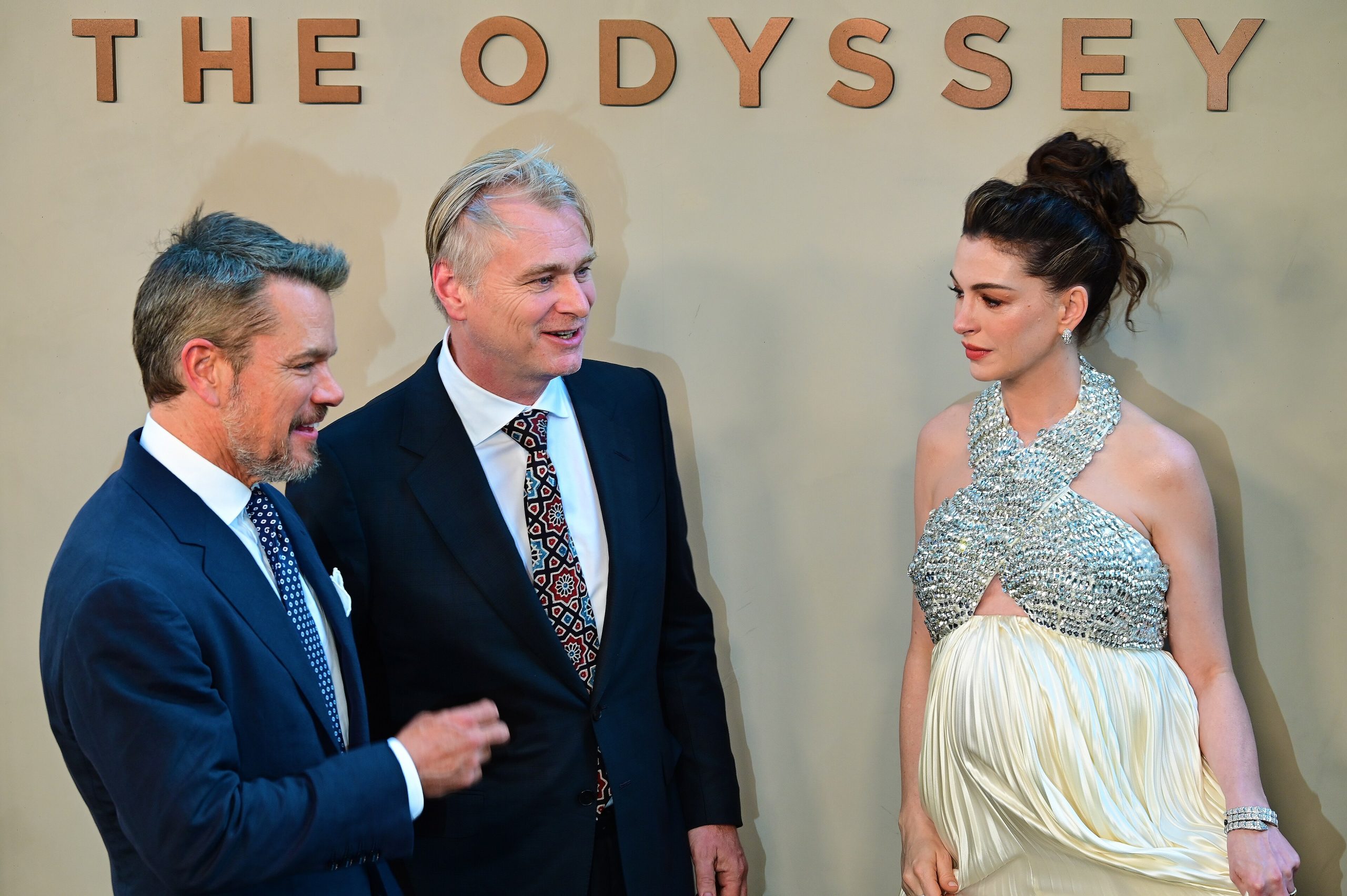
The Odyssey isn’t simply about getting home. It’s about whether home is still possible after you’ve become someone else.
The Odyssey, Nolan, and the Cost of Devotion
This tension – between calling and ordinariness, between mission and presence – appears everywhere in storytelling. It is the structure of The Odyssey: the hero who returns home changed, reshaped by the journey, unable to simply resume the life he left. Odysseus does not come back as the man who departed for Troy. He returns in disguise, tests his household, and even after reclaiming Ithaca, the restoration is not effortless. The voyage has altered him.
Christopher Nolan’s films repeat this pattern with almost obsessive consistency. His protagonists are called to extraordinary missions, and the missions are genuinely important. But success requires sacrifice, and the sacrifices accumulate until they threaten the very relationships that gave the mission meaning.
In Interception Cobb may return to his children, but grief has carved permanent channels in him. In Interstellar Cooper reunites with his daughter Murph only briefly; their original life is gone. Oppenheimer gains scientific immortality while losing peace of mind. Bruce Wayne saves Gotham at the cost of parts of himself he can never recover.
Nolan’s characters achieve something, but achievement transforms them. Returning home becomes psychologically harder than simply walking through the door.
If you extend this dynamic to Nolan himself, the irony becomes poignant. Each film becomes the next impossible voyage. Each project larger, riskier, more ambitious. He may tell himself that after this one, there will be time to rest, to be fully present with his family. But success raises the stakes. The next challenge appears. The identity of “the most powerful director,” “the filmmaker who can do what no one else can” becomes harder to set aside. At the core, home may remain emotionally central, yet the person trying to return has been reshaped by the voyage.
Whether or not this describes Nolan’s own life and his feelings of guilt is beside the point. His films repeatedly return to this tension, suggesting that it is one of the questions that most deeply preoccupies him.
The Odyssey isn’t simply about getting home. It’s about whether home is still possible after you’ve become someone else.

Image Credit: Nicola Quirico, CC-BY-SA-4.0
When Devotion Turns Into Obsession
Across Nolan’s films, one question recurs: When does devotion become obsession?
Bruce Wayne’s mission is noble, but it may consume him. Cobb’s love for his dead wife Mal becomes pathological guilt. Cooper’s duty to humanity conflicts with his duty to his daughter. Oppenheimer’s scientific curiosity becomes entangled with ambition and prestige. Angier and Borden destroy themselves in pursuit of artistic supremacy.
It is almost as if Nolan distrusts single‑mindedness, while admiring it. The very qualities that make someone capable of creating Inception or The Odyssey – relentless focus, refusal to compromise, willingness to devote years to a single vision – are the same qualities his films portray as irredeemably fatal when left unchecked.
This tension is not unique to artists. It appears in the lives of therapists, philosophers, scientists, activists. The pattern appears everywhere. Alice Miller wrote profoundly about childhood trauma, yet her son later described emotional neglect. Even physicians sometimes neglect their own health. Marriage counselors struggle in their own marriages.
The point is not hypocrisy. It is that a mission can gradually become an identity, and once that happens, protecting the mission also begins to protect the self. From the inside, devotion feels virtuous. From the outside, especially to a child, it can feel like abandonment.
This is the ethical fault line: Can devotion to a universal cause ever be honorable if it consistently fails the particular people who depend on us?

Image Credit: Daniel Cooper, CC-BY-SA-2.0
The Greater Good, the Ego, and the Confusion of Vocation
We often speak of the “greater good” as though it were unquestionably noble. Yet that is precisely why it can become so seductive – and so difficult to question. Behind appeals to the greater good there can also hide a subtle investment in one’s own importance. Not necessarily vanity, and certainly not always conscious. Rather, the desire to be significant, to matter on a larger stage, to believe one’s life serves something exceptional.
If goodness were understood as inherent to being human, it would not need to be performed. But because we often imagine ourselves fundamentally lacking, goodness becomes something to achieve – and greatness becomes one possible proof of it.
If goodness were understood as inherent to being human, it would not need to be performed.
And beneath this temptation lies something even more primal: the preoccupation with legacy. Because we identify as mortal beings, we become obsessed with outliving our biology. We want to leave a mark, a trace, a story that continues after we are gone. The greater good becomes a stage on which we rehearse our immortality.
Beneath this lies something even more universal: our uneasy relationship with mortality. Because we know we will disappear, we become consumed with the idea of leaving something behind. A book. A movement. A company. A scientific discovery. A championship. A reputation. Legacy becomes our negotiation with impermanence.
You can see this tension in athletes, politicians, entrepreneurs – anyone who has tasted greatness. Novak Djokovic, even in the later stages of his career and with a family, continues to pursue records that no one thought possible. Whether that pursuit ultimately enriches or impoverishes ordinary life is something only those closest to him could answer. Yet, it illustrates the enduring pull of legacy: once greatness becomes part of identity, stepping away is no longer simply retiring. It is relinquishing a version of oneself.
The Smallest Act as the Greatest Good
This brings us back to the Buddhist in the Muslim country, sitting in a tiny store, waiting for one person.
The story dismantles:
- the ego’s desire for scale
- the religious desire for expansion
- the activist desire for impact
- the spiritual desire for legacy
It suggests that the greatest good may be the smallest act – done for one person – and that this is enough for an entire life.
It is anti‑missionary. Anti‑heroic. Anti‑grand narrative.
It is a teaching about the singular act rather than the expansive, grand one.
Spirituality is not what happens in monasteries or foreign countries. It is what happens when you choose to be present with what is in front of you.
And outside religion, the story becomes even more universal:
What if your life is not meant to be big? What if your purpose is not collective? What if your impact is not measurable? What if meaning is not proportional to visibility? What if the whole point of your existence is one conversation, one encounter, one act that nobody else will ever know about?
This is the inversion of utilitarianism – a view where moral value is tied to expanding collective benefit. It is the embrace of the singular, the intimate, the specific.
The story seems exotic, spiritual, almost mythic. But the moment you bring it home, it becomes something else entirely.
Because the one person who walks through the door might not be a stranger. It might be your child. Your spouse. The person who lives in the next room.
And suddenly the metaphor reveals its deepest truth:
Ordinary presence is spiritual.
Not metaphorically. Not symbolically. Literally.
The living room is the temple. The kitchen table is the mandala. A child’s question is the koan. A spouse’s need is the prayer. A moment of attention is the transmission.
Spirituality is not what happens in monasteries or foreign countries. It is what happens when you choose to be present with what is in front of you.

The Missed Mission
This is where the metaphor becomes personal.
My father was not Christopher Nolan. He didn’t make films that reshaped culture. He didn’t carry the burden of global expectations.
But scale is always relative. Inside a family, the radius of influence is small.
To the outside world, he opened many stores. He helped patients. He was friendly, reliable, easy to get along with. He was a good doctor.
But at home, the store was closed.
Reclusive. Quiet. Uninterested. Unavailable.
The one person who walked through the door – me – found no one behind the counter.
And that absence mattered. Not because it was dramatic, but because it was ordinary. It shaped things. It left a space that could have been filled with curiosity, exchange, warmth, guidance – the smallest act that would have made the greatest difference.
This is the heartbreaking inversion of the metaphor:
The one person came. But the storekeeper wasn’t there.
We imagine purpose as something large because largeness reassures the ego.
Awareness rarely begins with ruling a country. It begins more like the old Taoist image of cooking a small fish – with careful attention and respect for what is immediately before us. And when vocation is mistaken for nobility, when mission is mistaken for moral grandeur, the ordinary presence asked of us begins to look too small, too quiet, too unremarkable.
A world at home does not begin with monuments or achievements. It begins with a conscious parent, a conscious mentor, a conscious adult – someone who meets the one person who walks through the door.
We imagine purpose as something large because largeness reassures the ego. We imagine meaning as something measurable because numbers comfort us. Yet awareness unfolds differently. It appears in the singular encounter, in the ordinary conversation, in the quiet act of showing up for the person who happens to be standing before us.
The smallest act is not small because it affects only one life. It is great precisely because every life is encountered one person at a time.
The one person who walks through the door may never be a stranger. It may be your child. Your spouse. Your friend. Or the person you become when, at last, you are willing to be fully present.
You may also like

The same system that shaped Harvey Weinstein also shaped the women in his orbit — and the people who raised him
Trigger warning: If you have been a victim of sexual assault or if you're a mother, this essay…
Lady Gaga – Beyond positivity, the necessity of embracing our shadows
If you cannot accept your shadows or learn to integrate them, your light will never be as bright as…
The Dark Truth Behind Celebrity Overdoses: Why Our Search For Blame Is Missing The Bigger Picture
Addiction is a devastating reality, and when loved ones like Matthew Perry’s stepfather, Keith…