
VIEW
IN A NUTSHELL
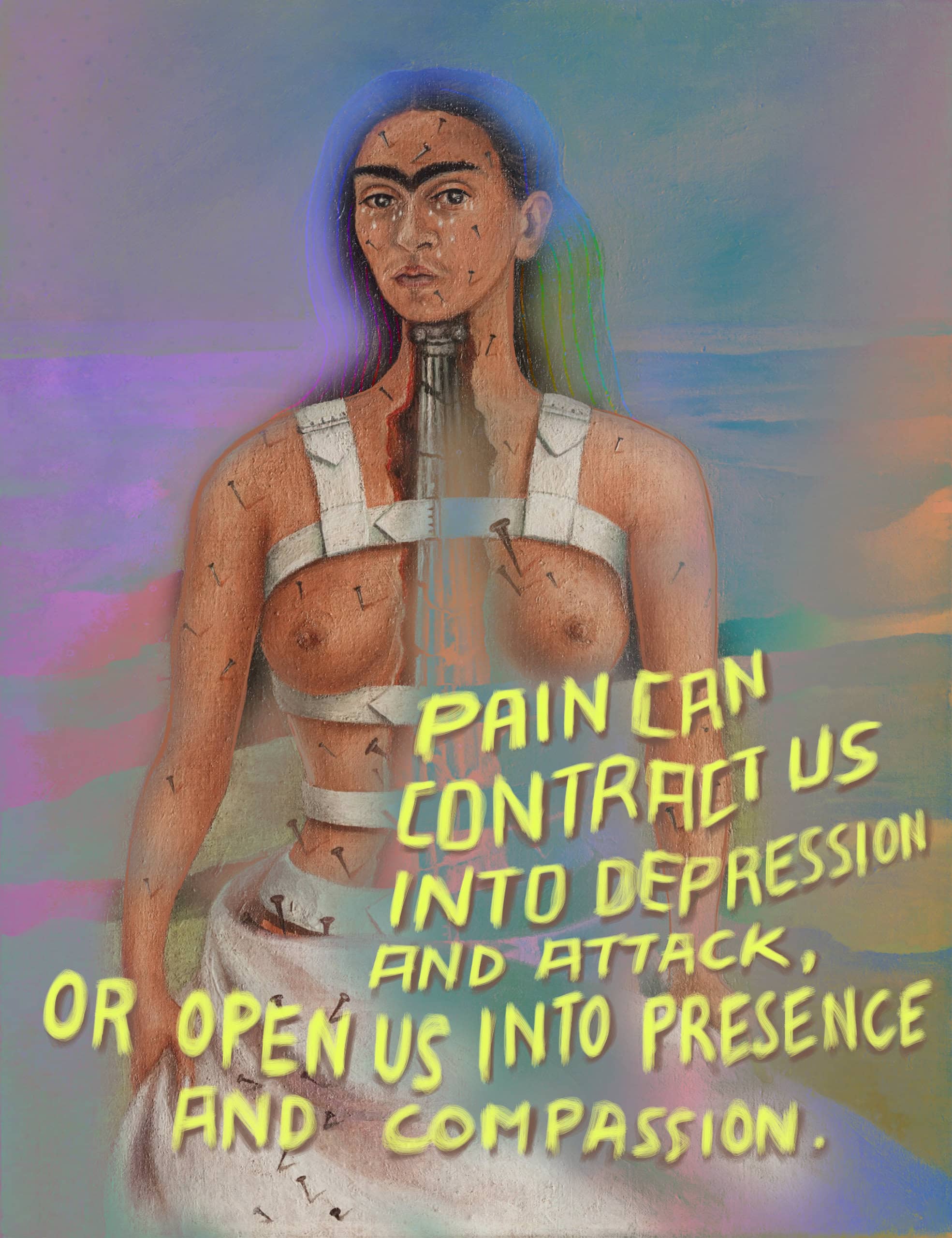
Unacknowledged Pain
Most “collectives” fail not because their ideals are wrong but because their trauma is unacknowledged.
From the millions of human stories, systems, cultures we get exposed to, the same patterns show up consistently, again and again, that it borders on predictability how reliable they are.
When humans are not safe, they contract. When they contract, they organize around protection. When they organize around protection, they create systems of control. Those systems always generate hierarchy. Hierarchy always produces disconnection. Disconnection always produces cruelty, even in people who think they are good.
That is the collapse loop.
The acceptance loop is just as consistent:
When humans feel safe, their nervous systems soften.
When they soften, they become open instead of defensive.
Openness creates connection.
Connection creates compassion.
Compassion creates synergy.
Synergy creates self-organizing systems that do not need to dominate.
From billions of examples, across parenting, relationships, communities, companies, and states, the same thing happens over and over:
People do not become cruel because they are evil.
They become cruel when their system is organized around fear rather than safety. And it is not material security they lack, but emotional safety.
What is uncomfortable but true:
Most “collectives” fail not because their ideals are wrong,
but because their trauma is unacknowledged.
They talk about love while practicing coercion. They talk about unity while enforcing conformity. They talk about freedom while punishing deviation.
The Architecture of Suffering
When a system becomes organized around its own survival instead of metabolizing pain, it produces aggression, polarization, control, and eventually collapse.
This is what also happens in families. Born into a family, a child encounters this relational field as the first system.
When the adults in that system have not metabolized their own pain – fear, shame, anger carried from their own childhoods – that pain does not disappear. It leaks into the field. It moves through tone, energy, absence, intrusion, unpredictability. And it flows toward the most vulnerable: the child.
Objectification is what happens when a dysregulated adult relates to a child not as a being, but as a regulator. The child becomes something that soothes, stabilizes, mirrors, or carries what the adult cannot hold.
To survive, the child must give up their own center and orient toward another’s unmet needs. This is not pathology. It is survival.
Where there is no emotional safety and no attuned guidance, the child turns away from its own consciousness, and splits into one part that adapts and one that hides.
The nuclear family does not fail because people are bad. It fails because two dysregulated adults cannot create a stable enough field for a developing being that is open and receptive. Basically, neglect and enmeshment are two expressions of the same breakdown. It becomes evident that the nuclear family was never meant to carry what belongs to a larger relational group.
As the child becomes an adult, unprocessed pain moves forward in time. Into relationships. Into work. Into new homes and new children. This is how transgenerational trauma is transmitted.
Not because people want pain, but because it feels like home.
Messy families create a messy world. (And a messy world creates messy families.)
These patterns are not random.
When a system becomes organized around its own survival instead of metabolizing pain, it produces aggression, polarization, control, and eventually collapse.
That is the architecture of suffering.
The Path of Integration - Liberation & Unity
Compassion arises when all of experience is welcomed into awareness, nothing exiled, until nothing resists.
Awareness is the base of liberation. To see a pattern is already to step out of it.
Survival strategies are not identity. Likes and dislikes are not identity. Roles are not identity. This understanding softens resistance. It makes presence possible. It opens the body.
Human suffering is real. But it does not have to be endlessly repeated. Pain is not the enemy. It appears when everything else has failed to reach you from the inside. It may signal what is out of alignment. It may point to hidden beauty. It may reveal what is still alive beneath. It may be the force necessary to open what has long stood shielded behind armor and defense.
Acceptance – including acknowledging pain – is not pretending everything is fine. It is not bypassing. It is not positivity. It is the willingness to open up to what is, without hardening or fleeing.
Own the envy, the greed, the capacity for harm. Accept the reality of your ordinariness and the weight of your failings. Breathe into your humanness, your imperfections and contradictions. Your real power begins where the need to be a saint ends. This is how fragmentation begins to fall away by itself.
This is integration. Standing inside what is, without turning away. Inside grief. Inside rage. Inside tenderness. Inside love. Nothing excluded.
Compassion arises when all of experience is welcomed into awareness, nothing exiled, until nothing resists. Until what remains is unity. And the quiet remembering: we are essence, moving through a human body, experiencing being alive.
Being Your Own Master
Awakening is the end of confusion about who you are.
What comes with the realization that you are consciousness? When the sense of being “someone” loosens, what changes is not the world.
Awakening is not a high. It is the end of confusion about who you are. No more mistaking the nervous system for identity. No more mistaking roles, trauma, thought, memory, or personality for essence. The confusion ends.
Life does not. Breath still breathes. The body still needs food, clothing and shelter. Old patterns still arise. The nervous system still flinches. “Love” still hurts. But none of that tells you who you are anymore.
What changes is the reference point. What drops is the extra layer that said “This should not be happening to me.”
You might have expected fireworks. Because the human mind wants compensation. If I suffer all this, I want a prize. Light. Bliss. Powers. A new identity. Something special. But that is still the addiction to becoming someone.
You recognize who you already are. What actually happens is quieter and much more unsettling: There is no longer anyone left to be impressed. Just the almost ordinary miracle that reality is no longer being resisted from the inside. And that feels more like being gently unhooked from a lifelong contraction.
Eventually, you will step out of religious institutions, spiritual communities, and all systems that have not faced the pain moving through them. When you enter such systems to find freedom, you usually end up absorbing fear, aggression, hierarchy and control instead. How can you discover your own authority while you are busy following?
Who knows you better than anyone? Who has been with you all the way? You. To be your own master trust that you have everything it takes.
After years of abandoning yourself to meet other people’s needs, to meet conventions, roles, expectations, at some point you will come home. Not to an improved version, but to the one who never left.
Life is the Practice
What changes is how you relate.
To pain.
To pleasure.
To other people.
To yourself.
Life lived from here does not look different.
At the end, the river is again the river,
the mountains again the mountains.
What changes is how you relate.
To pain.
To pleasure.
To other people.
To yourself.
Life itself becomes the practice.
A sacred life.
Finding the sacred in the mundane,
and the mundane in the sacred.
You continue living, only now with the default that you are consciousness, essence.
Whenever you get distracted – like in meditation – you notice. You return. You notice again.
You return again.
Over time the returning becomes home.
And when you live this way,
wide open, your heart becomes so unarmored
that when a mosquito lands on it,
it aches.
You realize this is what it means to be essence in a human body.
Not to escape being human,
but to be it fully.
Radically – from the root (lat. radix).
Not armored.
Not defended.
But alive
and compassionate all the way through.
What comes after realization is not the end of the path of integration.
It is the moment you finally have the ground
to walk it.
You may also like

VISION: We as a collective
In a world shaken by climate change, endless wars, emotionally stunted leadership, and an economy…

Abuser and Abused
Beyond the roles we assign - victim and perpetrator, or abuser and abused - lie invisible legacies…