Presley Gerber: The Child Who Carries What the Family Cannot Hold

Image Credit: Instagram @cindycrawford
Presley Gerber – son of former supermodel Cindy Crawford and businessman Rande Gerber, brother of model Kaia Gerber – died at 27, in a rehabilitation facility, of a suspected overdose.
I don’t know the Gerber family. So I am not going to pretend that I know what happened inside that family. But I recognize something.
And I think there is a difference between claiming to know someone’s story and recognizing a pattern. I have seen this pattern before. Again and again. In families whose tragedies make the news. In the Reiners. In the Pannetieres. In the Gerbers.
Different people. Different families. Different circumstances. Different stories.
But sometimes the same tragic pattern keeps appearing.
One child becomes the problem. The one who is struggling. The one with the addiction.
The one who becomes psychologically unstable. The one who needs treatment. The one whose behavior becomes the family’s central concern. And the rest of the family organizes itself around that person.
I recognize it because I grew up inside a family where this pattern was at work. And it destroyed our family. The question wasn’t that there wasn’t “love.” There was. Openly expressed or not.
One child becomes the problem. The one whose behavior becomes the family’s central concern. And the rest of the family organizes itself around that person.
I recognize it because I grew up inside a family where this pattern was at work. And it destroyed our family. The question wasn’t that there wasn’t “love.” There was. Openly expressed or not.
Most people think that if there is love, there cannot be harm. But both can coexist.
And the more unconscious we are about the harm and hurt we can inflict on the people we love – the people closest to us – the more unconsciously we can pave the path to destruction.
We think love is about keeping someone safe. Keeping them from loss. From mistakes. From pain.
But sometimes we don’t see that we are doing all of these things because we cannot bear to watch someone we love choose “wrongly,” struggle, fail, or suffer. We try to control the outcome. We call it love. We call it protection. We call it caring. While we are protecting ourselves from having to experience our own helplessness. And we never learn that that is control, not love.
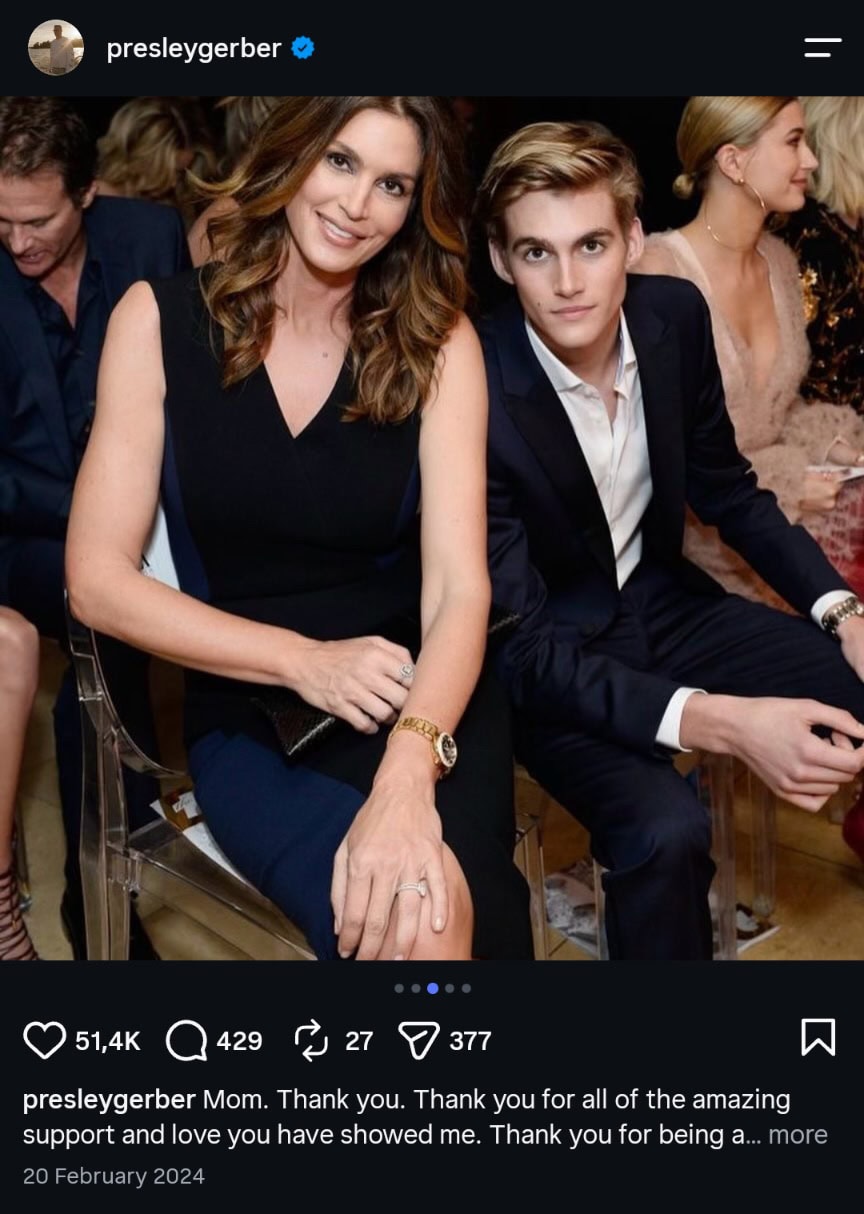
Image Credit: Instagram @cindycrawford
Love, in its truest meaning, is an open hand. It is trust. Not necessarily trust in the other person to make the choices we ourselves would make.
But trust in yourself – that whatever life brings, you can meet it. That you can handle it. Digest it. Carry it. That you don’t have to control another person’s life in order to survive what their life brings.
When “love” becomes the justification for control, we may unknowingly be choosing a path that can end in tragedy.
I grew up inside a family system where roles were not simply personality traits. They were ways of keeping the system functioning. You learn who you are allowed to be. You learn what you are allowed to need. You learn what must not be said. You learn who carries the tension. And you learn very early what happens when you disturb the arrangement.
Kaia Gerber said something that made the pattern even more recognizable. She described herself as “the easy one” and said she never wanted to ask for help because it felt like too much to have two children who were needing.
One child needs. Another becomes the child who doesn’t.
One becomes difficult. Another becomes easy.
And both children are adapting to the same system.
The roles don’t exist independently.
They exist in relation to one another.
If one child becomes the identified problem, another child can become the identified non-problem. The successful one. The one who doesn’t make trouble. The one who doesn’t need anything.
And that child may look like the lucky one. Until you realize that not needing can itself be an adaptation. I was the one who didn’t make but had to solve problems. The one who cared for others, but was left on my own when I needed help. Not out of malice but because I was seen in my role, in my function. The person who could handle it. The person who would figure it out. The person who could carry what needed carrying. At some point, the role becomes so familiar that people stop seeing the person inside it. And you can stop seeing yourself there, too.

Image Credit: Instagram @presleygerber
The hyper-independence I developed was not simply a personality trait. It was an adaptation to a system that had no room for the script to change.
Kaia also said that her parents had been very private for most of their lives, and described her brother as an “absolute teacher” who said, “I’m gonna be very human for everyone.”
Human as in not perfect. Human as in a being, not a role. Human as in vulnerable. Human as in needing true connection.
At some point, the role becomes so familiar that people stop seeing the person inside it. And you can stop seeing yourself there, too.
Presley had once had the word MISUNDERSTOOD tattooed directly underneath his eye.
His parents were reportedly very worried about it, and he faced heavy backlash online. People mocked him as a “rich mommy boy who wants so bad to be gangsta.”
He explained that the tattoo reflected how he had felt for much of his life.
Imagine feeling misunderstood for much of your life. Imagine carrying something inside you that has no real space to be expressed, and eventually expressing it in a way that makes people misunderstand you even more.
The message becomes the proof. And then the very thing you are trying to communicate becomes another reason people don’t understand you.
Years later, he had the tattoo removed.
I don’t know what that tattoo meant to him beyond what he himself said about it. But I can’t help seeing the painful possibility in it: sometimes what has no room to be spoken will find another way to make itself visible.
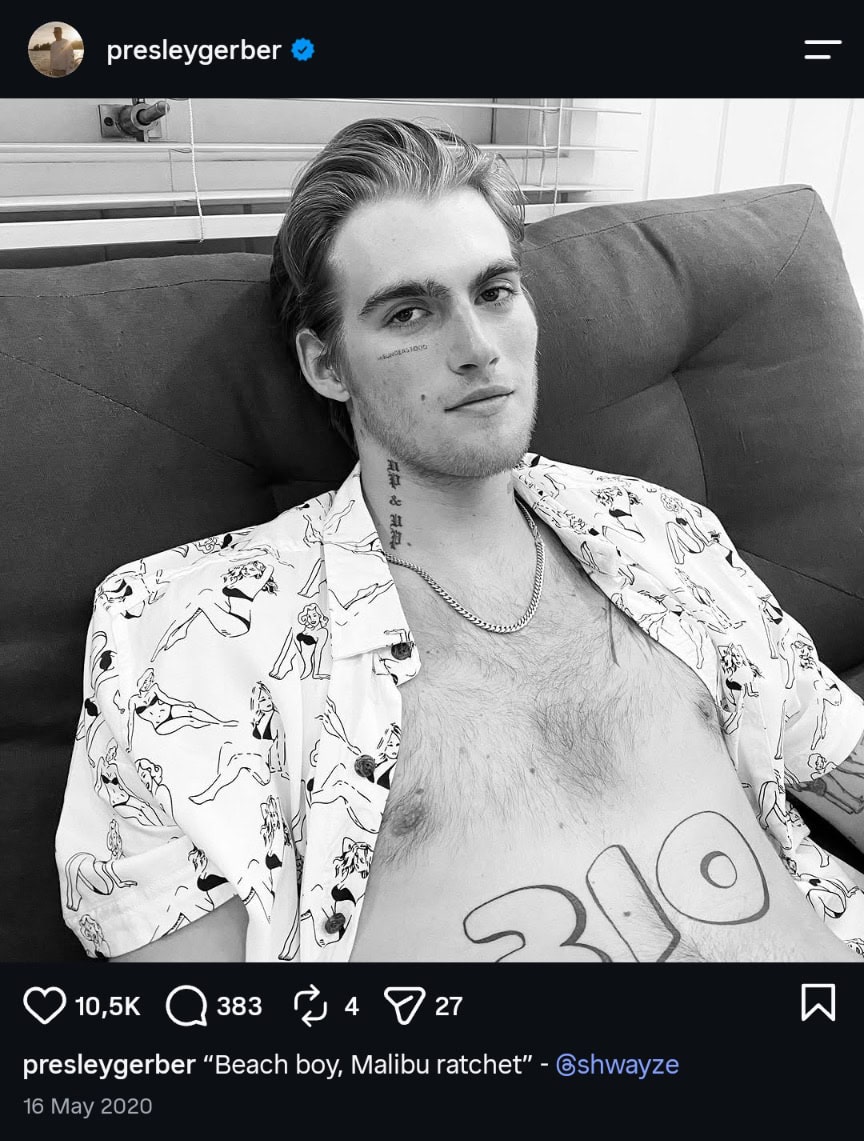
Image Credit: Instagram @presleygerber
The family that keeps itself together through privacy and image can have a very difficult relationship with the person who makes what is hidden visible.
If your image becomes more important than allowing the mess, the helplessness, the insecurities, the lowliness to have a place, it will come out through another door.
Something has to carry what the system cannot hold. And sometimes that something is a person.
I know this because my brother was the identified problem in our family.
When he was seven, he was the kind of child Walt Disney might have recognized immediately: the child other children naturally gravitated towards. He didn’t even speak their language. We were fresh immigrants. And yet, he could draw in boys and girls alike. Even at an age when girls weren’t particularly interested in boys, they were drawn to him. He had something in him.
By eleven, he was the problem child.
If your image becomes more important than allowing the mess, the helplessness, the insecurities, the lowliness to have a place, it will come out through another door.
While my father kept his distance from our upbringing, my mother had a fixed idea of what she needed us to be. There was a script. A picture of what our lives were supposed to look like — and, underneath it, a belief that if we became those things, our lives would be secure.
Lori Loughlin had a similar idea of what would secure her daughters’ future: admission to elite universities, the status and opportunities that came with it, a place among the highest tier of society.
I am not interested in judging neither her or my mother for wanting a good life for her children. I am interested in what happens when a parent’s idea of a child’s future becomes more important than the child who is actually standing in front of them.
Because then the child is no longer simply a human being discovering who they are. They become a project. And once a child becomes a project, everything that does not fit the picture becomes a problem.
And this is where I think we misunderstand so much about the person who has become the problem. We ask them to change. To get sober. To get therapy. To regulate. To take medication. To behave differently. And sometimes all of those things are necessary.
But if we only change the person and never examine the system around them, we may be treating the symptom while leaving the conditions that organized the symptom untouched.
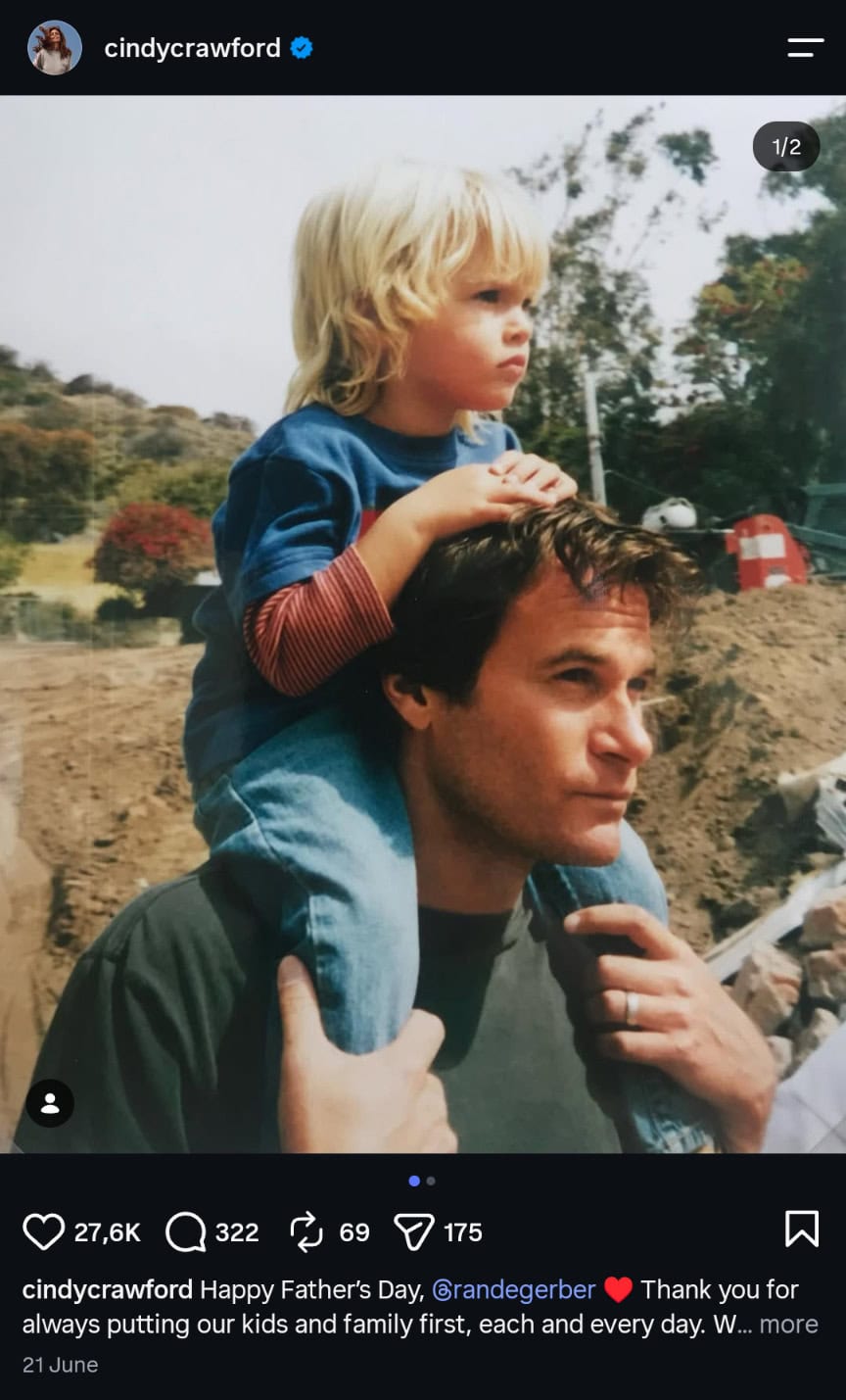
Image Credit: Instagram @cindycrawford
Because the question is: What function does this person’s problem serve in the family system? What does everyone else get to avoid because this person becomes the problem? What doesn’t have to be felt? Who gets to remain the good one? And who carries the shame?
And once you have seen a system organize itself this way, you begin to notice it everywhere. Not because every family is the same. But because human beings are remarkably consistent in the ways we protect ourselves from what we don’t want to feel or see.
Sometimes we protect ourselves by making one person carry it. And sometimes that person spends their entire life trying to tell us: I’m not the problem. I’m showing you the problem.
And this is where my claim becomes bigger than the Gerbers.
Because I have seen versions of this pattern repeatedly. The family doesn’t necessarily consciously choose a scapegoat. Nobody sits around a table and says: Let’s put all our unresolved shit onto this child.
The question is: What function does this person’s problem serve in the family system?
Nevertheless, it starts with the parents. With what they haven’t resolved in themselves. Their conditioning, inherited patterns and wounds. What they don’t face becomes what the family cannot talk about. What they don’t feel becomes what the family cannot feel. What they don’t carry or bear becomes something someone else has to carry.
And this is where the roles begin. One child – often the sensitive one – carries what their parent or parents cannot. They express what everyone else has learned not to express. They point to what everyone else has agreed not to look at. They don’t leave alone what the family has learned to brush under the rug.
And because they keep bringing the thing nobody wants to see into the room, they become the problem. Not because they created the problem. Because they made it visible.
Parents look at that child and ask, “What is wrong with them?” As if they themselves had nothing to do with it. As if the child arrived that way. As if a child came into this world broken. But children don’t create the system they are born into. They adapt to it.
It happens through thousands of tiny adjustments. Through what gets rewarded. What gets punished. What gets hidden. What gets laughed away. What gets explained. What gets denied. What gets called inappropriate. What gets called crazy. What gets called addiction. What gets called sensitivity. What gets called a bad attitude.
Until eventually, one person has become the location where the family’s disturbance appears. And if you have become the dumping ground for everything the family system cannot hold, cannot feel, cannot face, cannot say – sooner or later, something will give.
It may become an addiction. A breakdown. A depression. A compulsion. A suicide attempt. A psychosis. A body that can no longer carry what the person has been carrying.
Not everyone develops the same symptom.
But when a person has been made to carry what the system cannot hold, the suffering does not belong to that person alone.

Image Credit: Instagram @cindycrawford
And then something even more interesting happens. The collective agrees that that person needs to change. And of course they may need help. Of course they may need treatment.
Of course they have their own responsibility.
I am not arguing against any of that. I am saying something else: If one person has become the identified problem in a family, looking only at that person is like looking at a surface crack in a deeper foundation problem.
Because the problem may not exist solely inside the person.
Families have a tremendous drive toward self-maintenance. They seek stability. Continuity.
Familiarity. They will often prefer a familiar dysfunction to an unfamiliar truth.
Because the system is not necessarily trying to become conscious.
I have tried to tell my father and my mother that I no longer want to be “Mrs. Wolf” – the female counterpart of the problem solver from Quentin Tarantino’s Pulp Fiction. The one who arrives when things have gone wrong and makes the problem disappear. The one who carries responsibility for the difficult things no one else wants to carry. I no longer want to be the clean-up team. The servant to everyone.
And of course, these conversations touch very sensitive places in the other person. Because when you stop playing the role that has helped a system function, you are not simply changing yourself.
You are changing the relationship. You are disturbing an arrangement that may have existed for years. And what feels to you like a simple statement—“I won’t do this anymore.”—can be experienced by the other person as attack. As criticism. As abandonment. As accusation.
Families have a tremendous drive toward self-maintenance. They seek stability. Continuity. Familiarity. They will often prefer a familiar dysfunction to an unfamiliar truth.
And then something else can happen.
What belongs to the system gets projected back onto the person who is trying to change it. Suddenly, you are selfish. You are cruel. You are ungrateful. You are the problem. And this is one of the strangest things about family systems: The moment you stop carrying what was assigned to you, you may become the problem for refusing to carry it.
This is why changing one person’s role can be so destabilizing. The system has a powerful drive toward self-coherence.
And if one person stops playing their part, the system will often try to restore the old status quo. Just because systems seek stability.
This is why I keep coming back to the scapegoat.
I recognize a pattern. I recognize the way a family can turn one person’s suffering into the family’s explanation for everything. I recognize the way one person’s visible dysfunction can allow everyone else to remain comparatively invisible.
I recognize the way the “useful” child can become invisible in a different way.
And I recognize the terrible irony: the person who appears to be breaking the family may sometimes be the person revealing where the family was already broken.
I know this pattern because I have lived long enough in it to recognize its shape.
That’s not the same as knowing what happened to Presley.
But it is enough to make me look twice.
And perhaps that is what I am asking for.
The willingness to look at the whole system when one human being becomes the place where everyone else’s discomfort can safely land.
Because the question isn’t: What’s wrong with this person?
The question is: Mum & Dad, do you realize that your idea of love can hurt?
You may also like

Tom Cruise told Hayley Atwell this Trick – How to stop running, stop hiding & face your fears
Hayley Atwell shared that when she struggled with social anxiety, Tom Cruise told her to identify…

Why celebrities are a perfect mirror to make the unconscious conscious
You may not care about them. You may think they are shallow, completely irrelevant to your life, or…
Zoe Saldaña’s Oscar win, one single word, and the painful truth it reveals
There is something undeniably revealing about Zoe Saldaña's reaction at the Oscars. Seeing an adult…