The Fire and Water Axis — How We Disown Our Drive
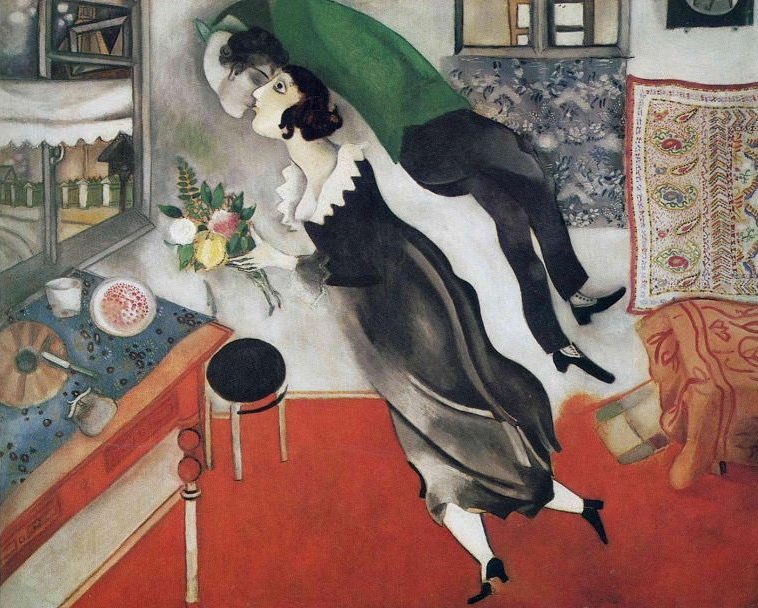
Marc Chagall’s The Birthday (or L’Anniversaire)
When discussing elemental architecture, Fire is usually described as active and Water as passive. But that distinction quietly falls apart once we look at what both elements actually do. Both move us. They simply move us differently.
Emotion comes from the Latin emovere — e-, out or from, together with movere, to move. To move out. To stir up. To agitate.
Stir up and agitate carry Fire’s jitter, its arousal, its forward push. Move out has a somewhat different quality it carries — a quality of being drawn out. The difference was never that Fire is the only element creating drive and Water the only that stays put and merely feels emotions. Both move us. They just move in different ways.
Fire’s version is familiar: I act, I direct, I act according to my own will. Water’s is quieter and easier to miss: I charge something with feeling, then experience that charge as a pull coming from outside myself — as longing, as emotional weight, as a force that moves me out toward it. The object doesn’t do the pulling. The charge does. And the charge was ours. We were the ones who put it there.
This is more honest than how we normally talk about longing, because longing is usually read as evidence of the object’s worth — I long for this because it’s precious — rather than admitting that value is a subjective thing: I feel pulled because I put emotional weight into something, and now that weight reads back to me as gravity. Which is also why longing feels like something happening to us rather than something we’re doing. The classic “passive“ or “victim“ view — an outside force controlling me — with no memory that the charge was manufactured by ourselves in the first place. And not because it’s dishonest. Because catching the moment of charging is genuinely hard to see while it’s happening.
Fire’s version of the same distortion: turning its own readiness to act into the world’s demand for action. Someone needed to take charge — as if the situation called for it, when the call was Fire’s own momentum, looking for an occasion.
Same structural error in both. Different felt texture. Directive in one case, magnetic in the other.
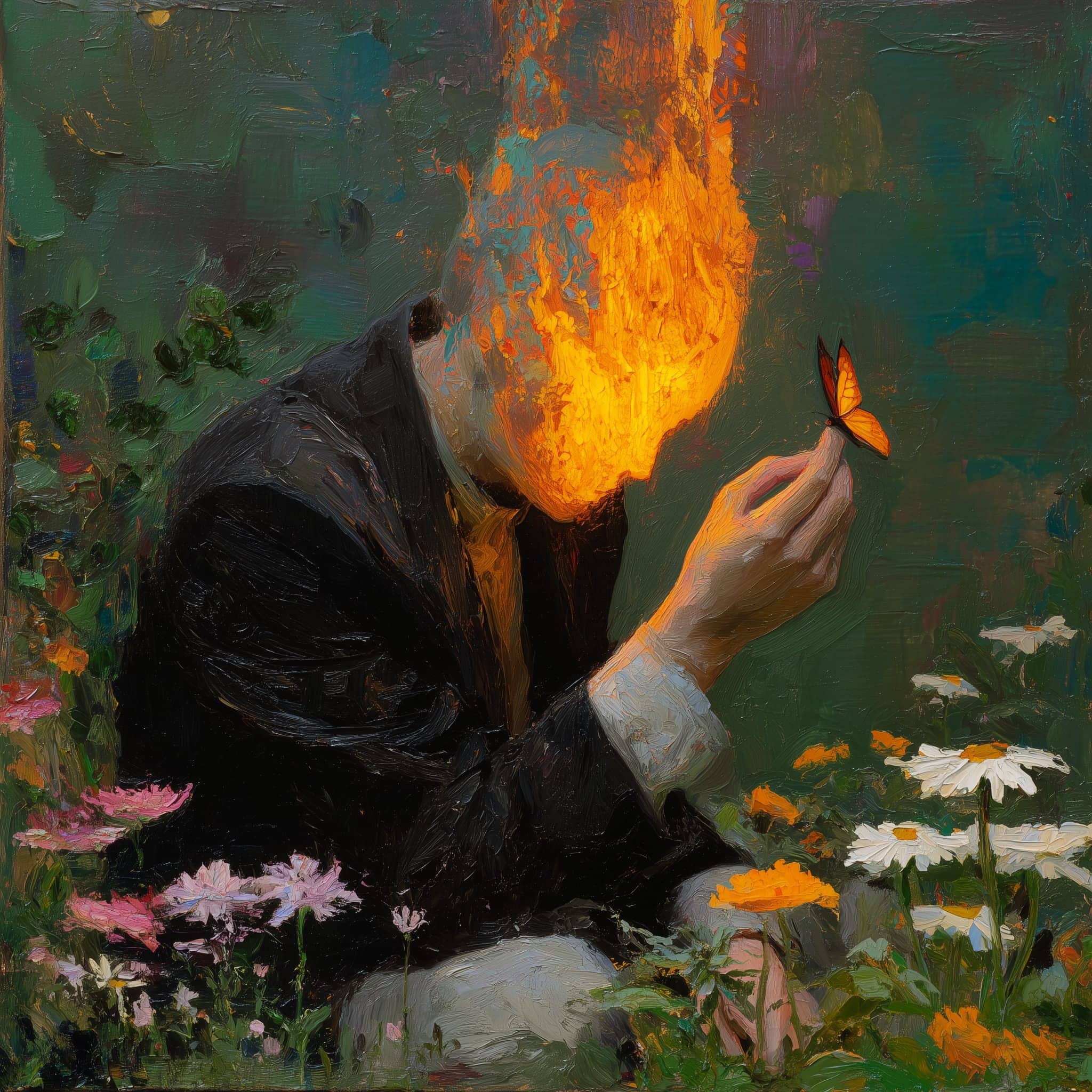
The difference was never that Fire is the only element driving us and Water stays put and merely feels emotions. Both move us. They just move in different ways.
And both expressions can be self-centered in their own way if we are unaware of them. Fire places itself at the center by pushing outward: I act according to my will. Water places itself at the center by experiencing everything as converging inward: the world is doing something to me. Perpetrator and victim are simply two postures around the same center of identification.
But there’s another layer underneath that, more about how awareness itself is organized rather than how our identification is postured — and here Water’s condition is closer to the opposite of Fire’s. Water can be lost inside its own projected charge, fear-based or desire-based, without being centered into a self at all. Not a strong self claiming what it feels entitled to. Something more like attention scattered outward onto the quality of connection to whatever’s been charged — watching, tracking, and often shaping the situation from underneath, invisibly, toward its own emotional agenda, while appearing to have no hand in it. Water isn’t as innocent as its passivity suggests. It has real tools. They just operate under the radar rather than in the open, the way Fire’s direct claims do.
Fire covers differently. The situation asked for it, I had to intervene isn’t mainly protecting Fire’s image from looking arrogant. It’s protecting something more load-bearing: the appearance of being in command, even in the exact moment command was lost to mere impulse. Fire’s function is to lead. An impulse that outran its own control isn’t embarrassing to Fire — it’s disqualifying. So the situation gets framed on outward circumstances, and what’s actually being hidden is the loss of steering, not the act itself.
Water’s cover runs the other direction. Showing desire means showing need, and need can be turned away. For Water, being refused isn’t losing the desired — it’s losing the bond the wanting was reaching toward. So the charge gets relocated outward — it’s pulling me — because if the reach never came from Water in the first place, it can’t get rejected.
Different function, same shape. Fire guards its need and capacity to lead. Water guards its need and capacity to belong. Each is protecting the one thing its element exists to do.
What the Latin already knew, before any of this got named: it was never emotion in one category and drive in another. It’s charge — put into physical tension, and we call it drive; put into emotional weight, and we call it pull. One drives us forward from our center. The other draws us magnetically out. Two words for the same thing happening through two different elemental mechanisms.
Neither Fire’s push nor Water’s pull started outside. It never was about what drives us but only to become aware of how we generate that drive all by ourselves.
You may also like

Is Our Experience Causal or Symbolic—Personal or Archetypal, Inherited or Chosen?
Human experience sits at the crossroads of three languages: the psychological, the mythic, and the…
What is authentic spirituality?
What is the quality of a spiritual practitioner, I asked myself? What is my own idea of…
Astrological Integration – Unlocking the secret identity of sister signs
In astrology the twelve zodiac signs form six pairs of opposing sister signs, each sharing a common…