Identity
The constructed self
Before we learn our name, before we know our gender, nationality, beliefs, preferences, ambitions, wounds, or personal history, something is already present.
Being comes first. Identity comes later. Identity is therefore not the foundation of our being. It is a construction built upon it.
From the moment we enter the world, a process begins. We are given a name. We are told who we are. We learn what is acceptable and what is not. We discover which expressions bring us closer to others, which create distance, and what seems to put our belonging at risk.
Slowly, a self-image takes shape: “I am smart,” “I am difficult,” “I am sensitive,” “I am strong,” “I am not good enough,” “I am special,” “I am too much.”
The child who learns to please may become someone who sees themselves as considerate. The child who learns to suppress vulnerability may grow into someone who prides themselves on being strong. The child who receives recognition for achievement may begin to believe that success is what makes them valuable.
What we initially learn to do gradually becomes something we believe ourselves to be.
This is how identity develops. We begin to develop an answer to a question: Who do I need to be? Not necessarily to a more fundamental one: Who am I?
Being comes first. Identity comes later. Identity is therefore not the foundation of our being. It is a construction built upon it.
Identity as Adaptation
Identity does not emerge in a vacuum. It develops through our attempts to navigate the world around us.
As children, we adapt. We learn what creates connection and what risks losing it. We discover which behaviors are rewarded, tolerated, discouraged, or ignored. We become sensitive to the expectations of our families, our peers, our culture, and our environment.
Many of these adaptations are intelligent responses to real circumstances. The child who keeps the peace becomes responsible. The child who cannot rely on others becomes independent. The child who receives attention for achievement becomes ambitious. The child who learns not to burden anyone becomes self-sufficient.
At first, these are simply things we do. They help us secure connection, safety, approval, or belonging. But because they work, we tend to repeat them. Over time, who we learned to be in order to survive gradually becomes who we believe ourselves to be.
This is a crucial transition.
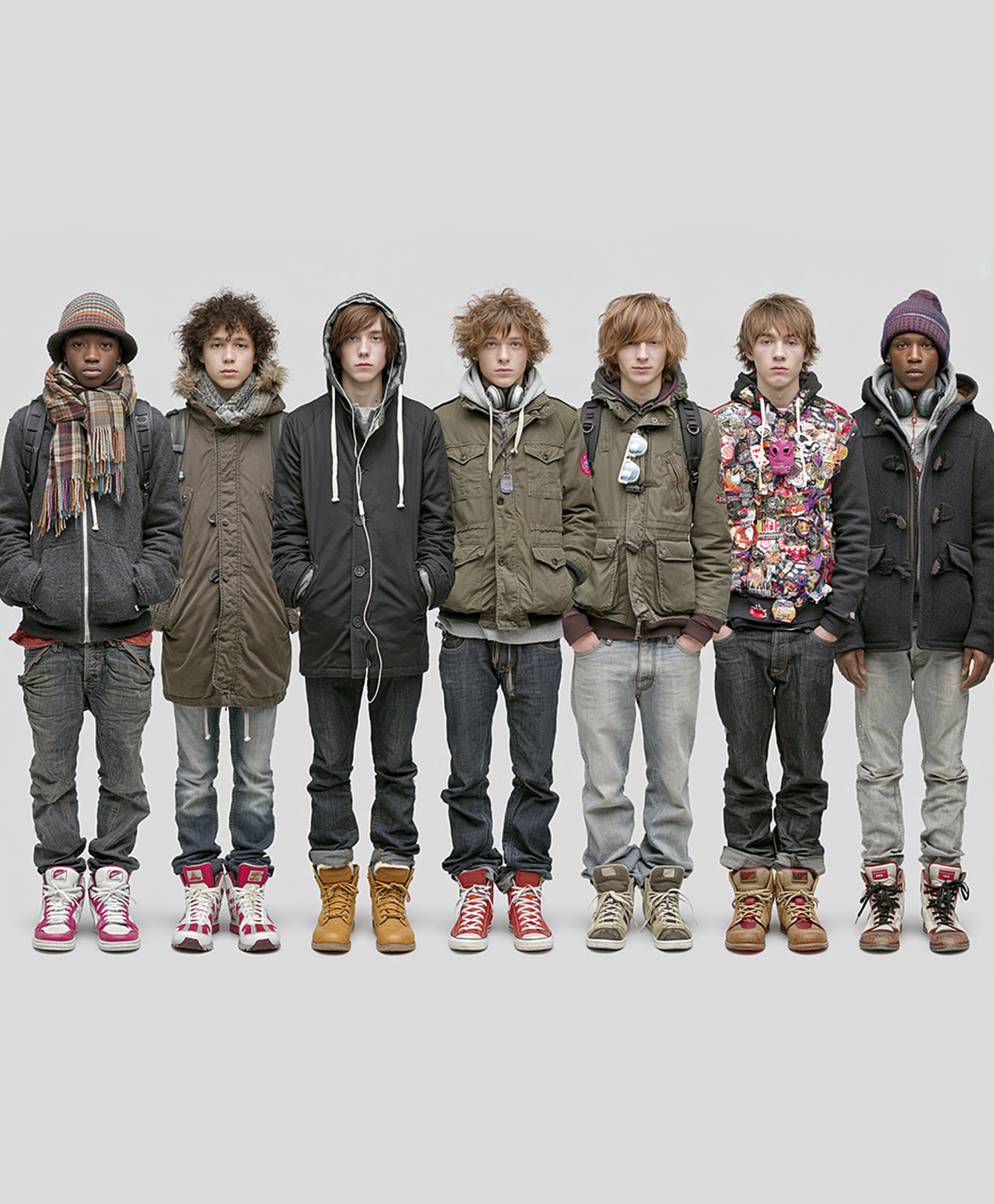
Instagram: Instagram: Exactitudes (Ari Versluis & Ellie Uyttenbroek) is a photographic project that documents social identities through grids of portraits.
Identity as Self-Image
As these adaptations are repeated, they gradually form a picture of ourselves.
We stop seeing them as behaviors and begin experiencing them as characteristics.
The person who routinely takes care of others comes to think of themselves as the caring one. The person who learned to stay in control becomes the strong one. The person who excels becomes the successful one.
What began as a way of relating to the world becomes part of our self-definition. This shift often goes unnoticed because it feels natural.
We no longer say, “I learned to be this way.”
We say: “This is just who I am.”
So, self-image is not simply the picture we have of ourselves. It is the point at which learned patterns become part of what we believe ourselves to be.
Over time, this self-image also begins to shape what we consider possible for ourselves. We gravitate towards what confirms the picture we have formed and may find it difficult to recognize or express aspects of ourselves that don’t fit it.
As these adaptations are repeated, they gradually form a picture of ourselves. We stop seeing them as behaviors and begin experiencing them as characteristics.
Identity as Coherence
Our lives contain contradictions. We experience confidence in one moment and self-doubt in the next. We want one thing today and another tomorrow. We carry competing desires, fears, loyalties, and aspirations.
Identity turns this complexity into a story. It creates a sense of continuity across time. It helps us make sense of our experiences. It provides a framework through which we interpret what happens to us, what we expect from ourselves, and how we relate to others.
Even identities that cause suffering can provide something deeply important: They make us feel coherent. A negative identity can be preferable to no identity because it provides an answer.
A diagnosis, a personal wound, a familiar role or a limiting belief can organize experiences that would otherwise feel disconnected and confusing.
Even if the answer is painful, at least we know where we stand.
Instagram: Exactitudes (Ari Versluis & Ellie Uyttenbroek)
Identity as Belonging
Many of our most meaningful connections are built around shared identities.
We find people who share our values, experiences, beliefs, struggles, interests, or worldview. Through identity, we become part of families, communities, professions, movements, cultures, and social groups.
This is one reason identities can become difficult to question. Changing an opinion may seem simple in theory. In reality, it can feel like risking relationships, community, or acceptance.
Sometimes the identity itself is not what we are protecting. Sometimes we are protecting the belonging attached to it. The identity becomes intertwined with the place we occupy in the social world.
Even identities that cause suffering can provide something deeply important: They make us feel coherent.
Identity as Protection
Identity also provides something less obvious. It protects us.
It helps us organize experiences that might otherwise feel confusing, uncertain, contradictory, or difficult to bear. It tells us who we are, what role we play, what we can expect from ourselves, and how we should understand our lives.
Without realizing it, we often use identity to not only help us avoid uncertainty. It gives us also a familiar framework within which uncertainty becomes more manageable.
Who would I be if I weren’t the responsible one, the helper, the independent one, the victim, the achiever, the rebel? What would I want from life if I weren’t the busy mother? Would I move to another country and start over if I no longer needed to see myself as successful? Would I leave the relationship if I weren’t so committed to being the loyal one? Would I speak up if I no longer needed to be the agreeable one? Would I rest if I didn’t believe my value depended on being productive?
We may avoid situations that expose what we don’t want to see. We may explain away experiences that contradict our beliefs. We may hold on to familiar roles because the alternative feels uncertain. We may protect an identity not because it makes us feel good, but because losing it would leave us without an explanation of who we are.
Sometimes an identity persists not because it reflects who we are, but because it protects us from the insecurity of not knowing. The identities we defend most fiercely are sometimes the ones we need most to protect us from questioning.
Instagram: Exactitudes (Ari Versluis & Ellie Uyttenbroek)
When Identity Becomes Something We Must Maintain
The more deeply we identify with a particular self-image, the more pressure we feel to remain consistent with it.
Someone who sees themselves as strong may struggle to ask for help. Someone who identifies as caring may find it difficult to pursue “selfishly” their own interests. Someone takes pride in being intelligent may avoid trying something new rather than risk feeling inadequate or having to confront the possibility of failure.
The experience itself is no longer the only thing at stake. We also have to contend with what it seems to say about us. Instead of asking what we genuinely feel, need, or want in a particular moment, we unconsciously ask whether it fits the person we believe ourselves to be.
We may remain in roles that have become too small. We may defend decisions we would no longer make. We may continue patterns that no longer serve us because they feel familiar.
The identity that once helped us navigate life begins to shape what we allow ourselves to experience.
We built the structure for safety. Only later do we notice that we are living inside it.
Sometimes an identity persists not because it reflects who we are, but because it protects us from the insecurity of not knowing.
The Vulnerability of Identity
The problem begins when a functional tool becomes an existential claim.
When “I am an artist” becomes more than a role. When “I am successful” becomes more than a temporary condition. When “I am a failure” becomes more than a passing interpretation.
The moment identity hardens, it can become vulnerable to change.
Bodies change. Relationships change. Beliefs change. Careers change. Circumstances change. Status changes. Even personality changes.
The more tightly we anchor ourselves to any particular identity, the more threatening those changes can become. A disagreement can feel personal. A failure can feel devastating. A changing circumstance can feel like a crisis.
Not merely because of what happened, but because of what it seems to imply about who we are. Sooner or later, life confronts every identity with its limitations.
The strong encounter helplessness. The independent need support. The successful fail. The knowledgeable discover what they do not know. And the person who thought they knew exactly who they were finds themselves standing in unfamiliar territory. And perhaps that is where another question begins.
Not: Who do I need to be?
But: Who am I (when I can no longer rely on the identity I have always taken myself to be)?
Most human suffering emerges from this confusion. Not because identities are inherently problematic, but because they were never designed to carry the weight of what we truly are.
Because the map is not the territory. And identity is not being.
Instagram: Exactitudes (Ari Versluis & Ellie Uyttenbroek)
You may also like

This Is How You Know Yourself: The Loop of Recreated Childhood Hurt—and How to Step Out of It
When we were abused or neglected in childhood—and still wait for our caregivers to acknowledge what…

The 3-D Map of Your Childhood Trauma
If you're reading this, you probably already know something was off in your childhood. Maybe you're…

Adaptation – From Being to Functioning
When you were a child, you were rooted. You couldn’t leave the environment you were born into, no…
